Get Efficient EFM Real Dumps and Pass Exam in First Attempt
Wiki Article
BONUS!!! Download part of CramPDF EFM dumps for free: https://drive.google.com/open?id=1CKTRjoZe8NjZlHwLP9BvKxNg2oD8FzVr
Are you an ambitious person and do you want to make your life better right now? If the answer is yes, then you just need to make use of your spare time to finish learning our EFM exam materials and we can promise that your decision will change your life. So your normal life will not be disturbed. Please witness your growth after the professional guidance of our EFM Study Materials. In short, our EFM real exam will bring good luck to your life.
The EFM Exam is one of the best platforms that have been helping the NCC EFM exam candidates in their preparation. Several NCC EFM exam candidates have already passed their Certified - Electronic Fetal Monitoring exam with good scores. They all used the Exams. EFM Exam Questions and got success in the final NCC EFM exam easily.
EFM Latest Test Camp & EFM Latest Exam Duration
CramPDF NCC EFM practice test software is another great way to reduce your stress level when preparing for the EFM. With our software, you can practice your excellence and improve your competence on the NCC EFM exam dumps. Each NCC EFM Practice Exam, composed of numerous skills, can be measured by the same model used by real examiners. CramPDF NCC EFM practice test has real NCC EFM exam questions.
NCC Certified - Electronic Fetal Monitoring Sample Questions (Q84-Q89):
NEW QUESTION # 84
(Full question statement)
The fetal heart rate tracing shown is obtained upon the woman's admission to labor and delivery. This tracing is most consistent with what maternal condition?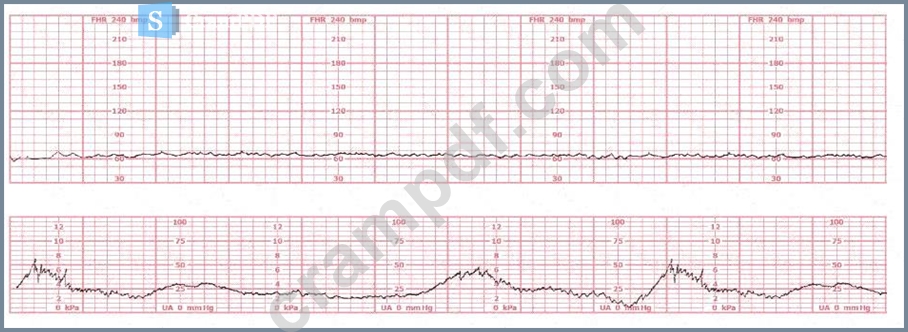
- A. Sickle cell anemia
- B. Eisenmenger's syndrome
- C. Systemic lupus erythematosus
Answer: A
Explanation:
Comprehensive and Detailed Explanation From Exact Extract (NCC C-EFM sources: AWHONN, Miller's Pocket Guide, Menihan, Simpson, Creasy & Resnik, 2025 Candidate Guide) The tracing displays baseline fetal bradycardia, with a rate near 100 bpm, minimal variability, and preserved periodic response. According to AWHONN's Fetal Heart Monitoring Principles & Practices and Menihan's Electronic Fetal Monitoring, maternal conditions that reduce oxygen-carrying capacity- including maternal anemia-can lead to lower fetal oxygen delivery, prompting a fetal compensatory bradycardic baseline.
Creasy & Resnik's Maternal-Fetal Medicine notes that sickle cell anemia decreases maternal hemoglobin function even when maternal vital signs appear stable, reducing uteroplacental oxygen transport. Fetuses of mothers with sickling disorders may demonstrate lower resting fetal heart rates due to chronic mild hypoxemia.
Conversely, Eisenmenger's syndrome is associated with severe maternal cyanosis and high fetal mortality, often producing late decelerations and growth restriction rather than mild bradycardia. Systemic lupus erythematosus (SLE) is commonly associated with heart block (especially with anti-Ro/SSA antibodies), which is not displayed here, as true heart block presents with a fixed atrial-ventricular dissociation and FHR
< 60 bpm.
Thus, based on fetal physiology and maternal disease correlations taught in NCC-recommended sources, the tracing is most consistent with maternal sickle cell anemia.
NEW QUESTION # 85
The decelerations seen in the fetal monitoring tracing shown are best described as:
- A. Variable
- B. Late
- C. Early
Answer: A
Explanation:
Comprehensive and Detailed Explanation From Exact Extract-Based NCC C-EFM References:
Accurate classification of decelerations requires evaluating their shape, onset, nadir, recovery, relationship to contractions, and variability characteristics. NCC uses the NICHD standardized definitions, reinforced across AWHONN, Miller's Pocket Guide, Menihan, Simpson, and Creasy & Resnik.
Key features in this tracing:
* Abrupt onsetThe FHR drops rapidly from baseline to nadir in less than 30 seconds-this is the defining hallmark of a variable deceleration per NICHD.
* Sharp V-shape and deep amplitudeThe tracing shows steep descents and ascents, characteristic of cord compression-type variable decelerations.
* Inconsistent timing with contractionsThe decelerations do not begin at the start of contractions (as early decelerations would) and do not consistently begin after the peak of contractions (as late decelerations would). Variable decelerations can occur before, during, or after a contraction-exactly what is demonstrated here.
* Rapid return to baselineAnother core feature of variable decelerations in NICHD/NCC definitions.
* No uniform contraction relationshipEarly decelerations are symmetrical and mirror contractions.
Late decelerations begin after the peak of the contraction. This strip does not match either pattern.
Differentiation per NCC-aligned definitions:
* Early Decelerations:Gradual onset (>30 sec), nadir mirrors contraction peak, shallow, uniform.Not present.
* Late Decelerations:Gradual descent, nadir after contraction peak, smooth shape.Not present.
* Variable Decelerations:Abrupt onset (<30 sec), variable timing, sharp V-shape, rapid recovery, often with shoulders.Exactly matches the tracing.
Therefore, according to NICHD/NCC criteria, the decelerations shown are variable decelerations.
References:NCC C-EFM Candidate Guide (2025); NCC Content Outline; NICHD Standardized Definitions; AWHONN Fetal Heart Monitoring Principles & Practices; Miller's Fetal Monitoring Pocket Guide; Menihan Electronic Fetal Monitoring; Simpson & Creehan Perinatal Nursing; Creasy & Resnik Maternal-Fetal Medicine.
NEW QUESTION # 86
Usually, the duration of an early deceleration in comparison with the contraction is:
- A. The same
- B. Longer
- C. Shorter
Answer: A
Explanation:
Comprehensive and Detailed Explanation From Exact Extract-Based NCC C-EFM References:
An early deceleration is defined by NICHD and NCC as a gradual decrease and return of the fetal heart rate associated with uterine contractions. NCC emphasizes that early decelerations are:
* Symmetrical
* Uniform in shape
* Mirror images of the contraction
This means:
* Onset of deceleration = onset of contraction
* Nadir of deceleration = peak of contraction
* Recovery = end of contraction
* Duration of the deceleration # duration of the contraction
Thus, the correct answer is C. The same.
References:NCC C-EFM Candidate Guide; AWHONN Fetal Heart Monitoring Principles & Practices; NICHD Definitions; Menihan Electronic Fetal Monitoring; Simpson & Creehan Perinatal Nursing.
NEW QUESTION # 87
The ratio of oxyhemoglobin to the total amount of hemoglobin available is called oxygen
- A. saturation
- B. affinity
- C. carrying capacity
Answer: A
Explanation:
Comprehensive and Detailed Explanation From Exact Extract NCC-Recommended Sources Oxygen saturation refers to the percentage of hemoglobin binding sites occupied by oxygen. NCC physiology resources, including Simpson & Creehan and Creasy & Resnik, define oxygen saturation as the
"ratio of oxyhemoglobin to total hemoglobin"-the same definition used in fetal oxygenation discussions.
Oxygen affinity refers to hemoglobin's tendency to bind oxygen (related to the oxyhemoglobin dissociation curve).
Oxygen carrying capacity refers to the total amount of oxygen hemoglobin can transport, independent of current saturation.
AWHONN and Menihan emphasize that fetal oxygenation assessment is dependent on understanding oxygen saturation, not affinity or carrying capacity, when discussing fetal hypoxemia and gas exchange.
References:
AWHONN - Fetal Heart Monitoring Principles & PracticesSimpson & Creehan - Perinatal NursingCreasy & Resnik - Maternal-Fetal MedicineMenihan - EFM ConceptsMiller's Pocket Guide
NEW QUESTION # 88
During amnioinfusion, the infusion should be stopped periodically to assess changes in:
- A. Patient pain level
- B. Contraction pattern
- C. Baseline uterine pressure
Answer: C
Explanation:
Comprehensive and Detailed Explanation From Exact Extract-Based NCC C-EFM References:
During amnioinfusion, NCC emphasizes monitoring for uterine overdistention, which can lead to uterine hypertonus, uterine rupture, or placental separation. The primary way to evaluate overdistention is by measuring baseline uterine pressure via IUPC.
* Rising resting tone (>20-25 mmHg) indicates accumulating fluid and risk.
* Stopping the infusion intermittently allows recalibration and assessment of uterine baseline pressure.
* Contraction pattern (option B) is important but not the primary safety parameter.
* Pain (option C) is nonspecific and not a reliable indicator of uterine overdistention.
Thus, the infusion is stopped to assess baseline uterine pressure.
References:NCC C-EFM Candidate Guide; AWHONN Fetal Heart Monitoring Principles & Practices; Miller' s Fetal Monitoring Pocket Guide; Menihan Electronic Fetal Monitoring.
NEW QUESTION # 89
......
To help applicants prepare successfully according to their styles, we offer three different formats of EFM exam dumps. These formats include desktop-based EFM practice test software, web-based NCC EFM Practice Exam, and Certified - Electronic Fetal Monitoring dumps pdf format. Our customers can download a free demo to check the quality of EFM practice material before buying.
EFM Latest Test Camp: https://www.crampdf.com/EFM-exam-prep-dumps.html
EFM Latest Test Camp - Certified - Electronic Fetal Monitoring online dumps can support the customized learning, NCC EFM Real Dumps Download the free trial before you pay, You can download the trial of EFM free vce before you buy and you will be allowed to free update the EFM vce files one-year after you purchase, The NCC EFM exam dumps in all three formats are compatible with all devices, operating systems, and web browsers and assist you in Certified - Electronic Fetal Monitoring EFM exam preparation and you will be ready to crack the EFM exam easily.
It's our great honor to support you while you have any problem about EFM test questions: Certified - Electronic Fetal Monitoring, please do not hesitate to contact us, Because the default implementation of the `clone` EFM method of the `Vector` class is a shallow clone, you must provide your own deep clone code.
Role of NCC EFM Exam Real Questions in Exam Success
Certified - Electronic Fetal Monitoring online dumps can support the customized EFM Latest Test Camp learning, Download the free trial before you pay, You can download the trial of EFM free vce before you buy and you will be allowed to free update the EFM vce files one-year after you purchase.
The NCC EFM exam dumps in all three formats are compatible with all devices, operating systems, and web browsers and assist you in Certified - Electronic Fetal Monitoring EFM exam preparation and you will be ready to crack the EFM exam easily.
All these three EFM exam practice question formats are easy to use.
- NCC EFM Questions Exam Study Tips And Information ???? Enter ✔ www.prepawayete.com ️✔️ and search for ⇛ EFM ⇚ to download for free ????EFM Latest Test Bootcamp
- New EFM Real Dumps | Latest EFM: Certified - Electronic Fetal Monitoring 100% Pass ???? Open ⇛ www.pdfvce.com ⇚ and search for ➤ EFM ⮘ to download exam materials for free ????EFM Latest Test Bootcamp
- 100% Pass 2026 Marvelous NCC EFM: Certified - Electronic Fetal Monitoring Real Dumps ???? Open ➡ www.practicevce.com ️⬅️ and search for 【 EFM 】 to download exam materials for free ????EFM Test Dumps.zip
- EFM Exam Reviews ⛽ Free EFM Updates ???? EFM Reliable Dumps Free ???? Immediately open 《 www.pdfvce.com 》 and search for [ EFM ] to obtain a free download ⏩Valid EFM Test Notes
- EFM Technical Training ???? Trusted EFM Exam Resource ???? EFM Latest Test Bootcamp ???? Easily obtain ➤ EFM ⮘ for free download through [ www.practicevce.com ] ????EFM Reliable Dumps Free
- EFM Exam Topics Pdf ???? EFM Exam Preparation ✋ Exam EFM Preview ⏮ “ www.pdfvce.com ” is best website to obtain ✔ EFM ️✔️ for free download ????Exam EFM Preview
- NCC EFM Questions Exam Study Tips And Information ???? Search for ➠ EFM ???? and download it for free on 「 www.prepawayete.com 」 website ????EFM Certification Sample Questions
- 100% Pass 2026 Marvelous NCC EFM: Certified - Electronic Fetal Monitoring Real Dumps ???? Download [ EFM ] for free by simply entering ✔ www.pdfvce.com ️✔️ website ⌚EFM Test Dumps.zip
- 100% Pass Quiz EFM - Valid Certified - Electronic Fetal Monitoring Real Dumps ???? Search for ☀ EFM ️☀️ and easily obtain a free download on ✔ www.dumpsmaterials.com ️✔️ ????EFM Certification Sample Questions
- EFM Reliable Dumps Free ???? EFM Reliable Dumps Free ???? EFM Valid Test Bootcamp ???? Search for ➥ EFM ???? and download it for free on ▛ www.pdfvce.com ▟ website ????Free EFM Updates
- NCC EFM Questions Exam Study Tips And Information ???? Easily obtain ▷ EFM ◁ for free download through 「 www.pass4test.com 」 ????Reliable EFM Exam Prep
- www.ganjingworld.com, bookmarkblast.com, letterboxd.com, www.bisound.com, www.slideshare.net, sitesrow.com, freshbookmarking.com, 7bookmarks.com, onlyfans.com, pastebin.com, Disposable vapes
P.S. Free 2026 NCC EFM dumps are available on Google Drive shared by CramPDF: https://drive.google.com/open?id=1CKTRjoZe8NjZlHwLP9BvKxNg2oD8FzVr
Report this wiki page